Opinion: I watched L.A. burn. Bozeman is next.
January 30 2025
On the morning of Jan. 11, I shuffled along Woodbury Road in Altadena, a Los Angeles (L.A.) neighborhood that has been devastated by the Eaton fire. Flecks of ash still were falling, giving the effect of light, carcinogenic snow. Most of the neighborhood was barricaded by the National Guard, and residents wearing N95 masks hovered near the tape, hoping to get a glimpse of their homes. The Santa Ana winds had toppled orange trees, and the fruit — charred to black lumps — littered the scorched remains of what had once been front yards. In the homes that were spared, vinyl blinds had melted against the window panes.
This catastrophic scene was straight out of the future we’ve been warned of and it is a scene that, I fear, we will have to get used to.
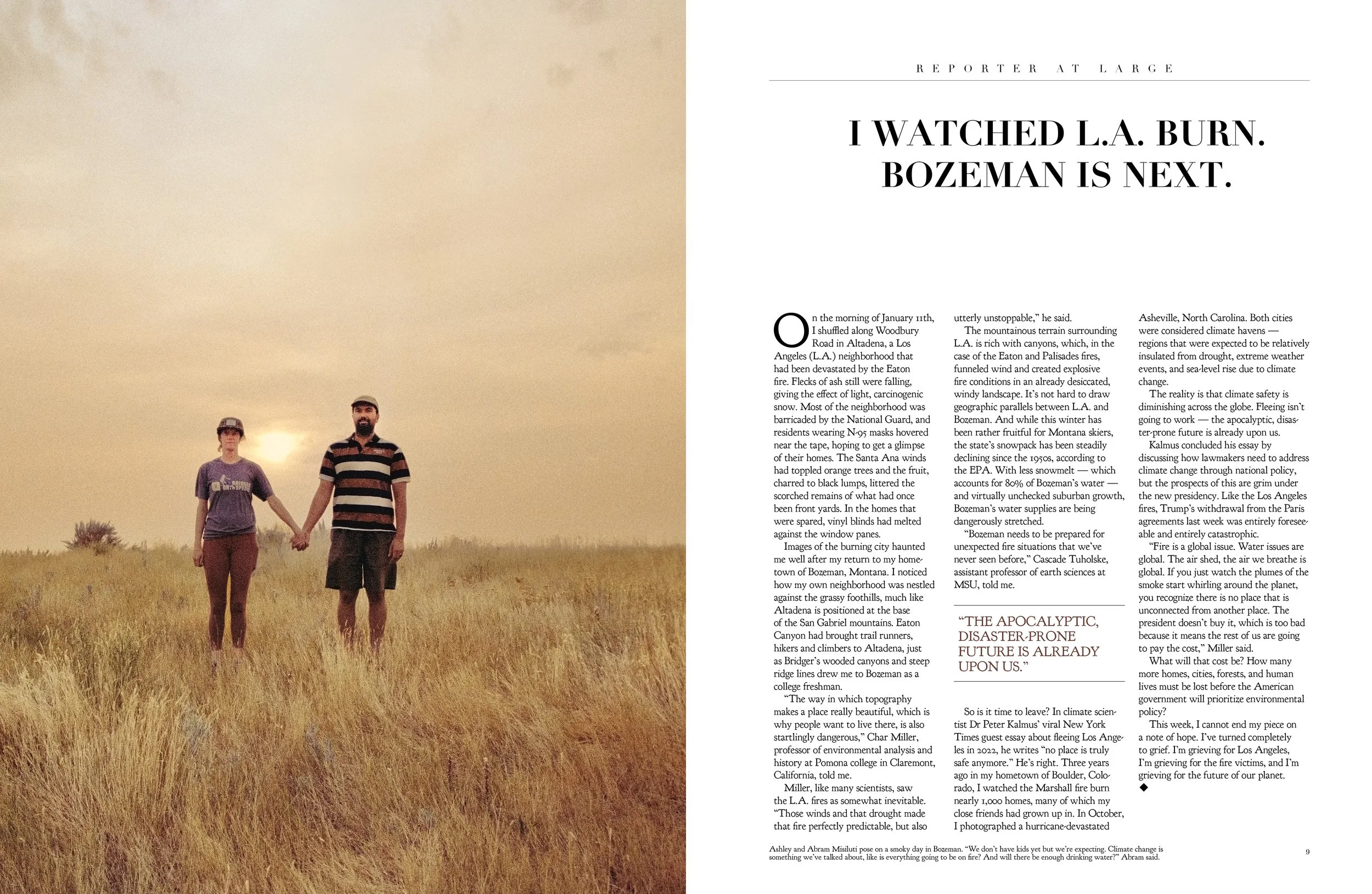
Images of the burning city haunted me well after my return to Bozeman. I noticed how my own neighborhood was nestled against the grassy foothills, much like Altadena is positioned at the base of the San Gabriel mountains. Eaton Canyon had brought trail runners, hikers and climbers to Altadena, just as Bridger’s wooded canyons and steep ridgelines drew me to Bozeman as a college freshman.
“The way in which topography makes a place really beautiful, which is why people want to live there, is also startlingly dangerous,” Char Miller, a professor of environmental analysis and history at Pomona College in Claremont, California, told me.
Miller, like many scientists, saw the L.A. fires as somewhat inevitable. “Those winds and that drought made that fire perfectly predictable, but also utterly unstoppable,” he said.
The mountainous terrain surrounding L.A. is rich with canyons, which, in the case of the Eaton and Palisades fires, funneled wind and created explosive fire conditions in an already desiccated, windy landscape. It’s not hard to draw geographic parallels between L.A. and Bozeman.
Additionally, while this winter has been rather fruitful for Montana skiers, the state’s snowpack has been steadily declining since the 1950s, according to the EPA. With less snowmelt — which accounts for 80 percent of Bozeman’s water, according to the City of Bozeman’s website — and what seems like virtually unchecked suburban growth, Bozeman’s water supplies are being dangerously stretched.
“Bozeman needs to be prepared for unexpected fire situations that we’ve never seen before,” Cascade Tuholske, assistant professor of earth sciences at MSU, said.
So, is it time to leave? In climate scientist Peter Kalmus’ viral New York Times guest essay about fleeing L.A. in 2022, he writes, “no place is truly safe anymore.” He’s right. Three years ago in my hometown of Boulder, Colorado, I watched the Marshall fire destroy nearly 1,000 homes, many of which belonged to close friends. In October, I photographed a hurricane-devastated Asheville, North Carolina. Both cities were considered climate havens — regions that were expected to be relatively insulated from drought, extreme weather events, and sea-level rise due to climate change.
The reality is that climate safety is diminishing across the globe. Fleeing isn’t going to work — the apocalyptic, disaster-prone future is already upon us.
Kalmus concluded his essay by discussing how lawmakers need to address climate change through national policy, but the prospects of this are grim under the new presidency. Like the L.A. fires, Trump’s withdrawal from the Paris climate agreements last week was entirely foreseeable and entirely catastrophic.
“Fire is a global issue,” Miller said. “Water issues are global. The airshed, the air we breathe is global. If you just watch the plumes of the smoke start whirling around the planet, you recognize there is no place that is unconnected from another place. The president doesn't buy it, which is too bad, because it means the rest of us are going to pay the cost.”
What will that cost be? How many more homes, cities, forests and human lives must be lost before the American government will prioritize environmental policy?
This week, I cannot end my piece on a note of hope. I’ve turned completely to grief. I'm grieving for L.A., I’m grieving for the victims of the fires and I’m grieving for the future of our planet.